Nature as Heritage: The Kungul Silk Foulard Story

Some of my earliest memories are of winter evenings when the world shrank to a small circle of light around the table.

Outside, the cold pressed against the windows. Inside, there was always a little glass of mountain tea, Sideritis syriaca, though no one ever called it that, pale gold, steaming, scented with sun and stone. While it cooled, my grandmother would start telling stories: goats dancing on knife-sharp ridges, rivers that refused to obey dams, fairies who guarded forests and punished anyone who hurt the land.

I didn’t have scientific words back then. I didn’t know “endemic species” or “natural product chemistry.” But I understood something that stayed with me: the land is not a background. It is alive. And every plant and every animal belongs to a larger, delicate story, one we inherit, whether we pay attention or not.

Years later, I found myself on those same kinds of slopes, but this time with a notebook, a lab and Latin names. My first scientific work was on the genus Centaurea, those tough, prickly thistles that grow where the soil is thin and the sun is harsh, including Centaurea kosaninii subsp. albanica, a rare endemic that exists only in a few of our mountains. Under the microscope I could see what my grandmother’s stories had already suggested: survival written in molecules, resilience turned into chemistry.

And that is exactly where the “beauty world” quietly begins. Many of the ingredients we rub into our skin every day are born from plants, from their extracts, oils, and active compounds,  just removed from their landscapes and packaged into glossy promises. That is why my path led naturally from wild slopes to ingredient lists, from mountainsides to bottles. Together with Erblina, we built Kungul to translate that hidden language into something people can actually use: the app reads formulas, flags problematic substances, and helps you choose personal care products that are kinder to your body.

But something was missing.

Kungul lived on a screen, inside glass and code, while the plants and animals that inspired us lived outside, under sky and rain. We wanted a way to bring these two worlds together. Not another product in a plastic bottle, but something you could touch, wear, and maybe one day pass on. A piece that would speak not only about clean formulas, but also about the land we’re trying to protect.

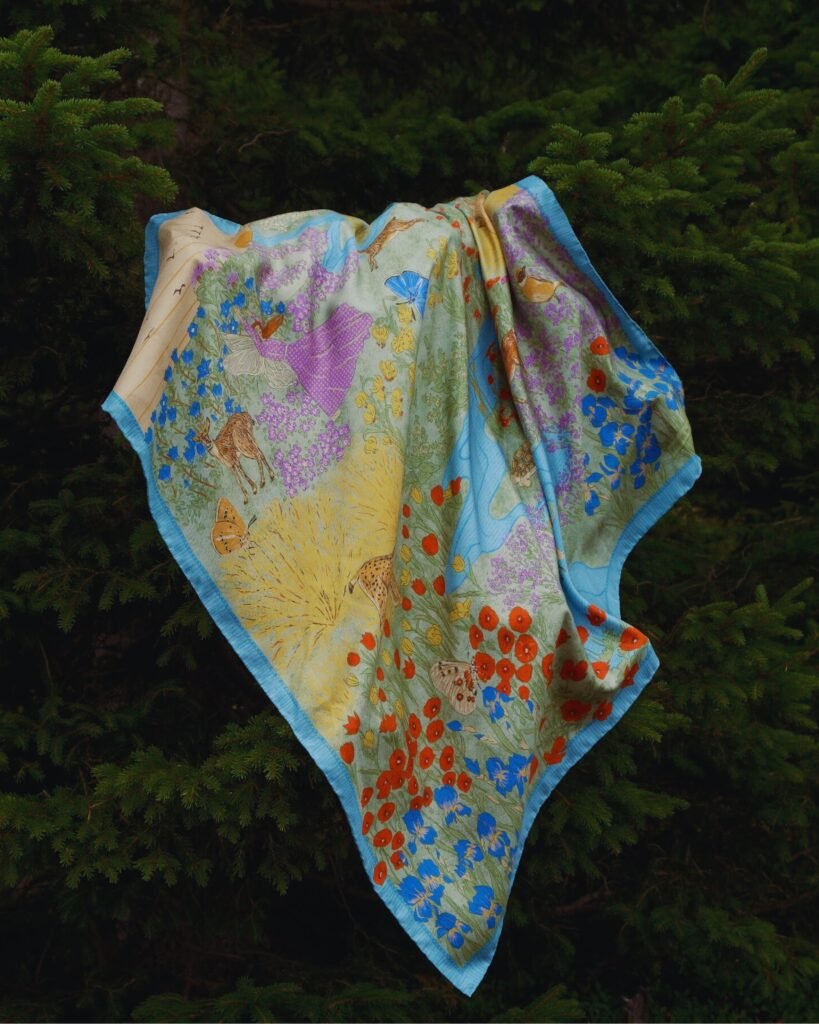
That is how the idea for the Kungul foulard was born: one square of silk that would carry an entire living map of Albania.

When the idea of the foulard became clear in our minds, we brought it to the Trivet sisters, three artists who immediately understood what we were trying to say. We arrived with a story and a brief: endemic plants documented by Albanian botanists, animals that still roam our mountains and wetlands, the Vjosa river, the fairy with three golden goats, the layers of science and folklore behind them. They translated all of that into illustration, turning research, names and memories into a moving composition of lines, colour and rhythm on silk.

But the most important thing is not the silk. It’s what lives on it. If you spread the foulard on your lap, the first thing you see is a river.

Around the outer edge, like a moving silver frame, flows the Vjosa, one of the last great wild rivers of Europe. On the silk, as in real life, the Vjosa refuses straight lines. It bends and twists, splits and rejoins, erases old paths and carves new ones. For us, it is more than a geographic detail; it is the symbol of a country, and of a way of being, that, at its best, still remembers how to choose its own course.

Inside this river-border, the foulard becomes a vertical journey through Albania: from the highest, coldest peaks down to the soft wheat fields and the sea.

At the very top, among pale rock and imagined snow, grows Leontopodium nivale subsp. albanicum, the Albanian edelweiss. Its small, white-silver stars look delicate, but they are perfectly adapted to brutal light and freezing winds: a symbol of purity and endurance in our alpine flora. Close to it, Wulfenia baldaccii pushes up bluish-violet flowering spikes from almost bare rock, one of the rarest plant treasures of the Balkans. Nearby, Edraianthus tenuifolius forms dense cushions of bell-shaped flowers clinging to tiny cracks in limestone, opening their blue-violet mouths to the sun while the mountain winds roar past.

In these same heights you find the plants that marked my early years as a scientist. Centaurea kosaninii subsp. albanica stands with its fine, violet rays fanning out from a dark centre, both elegant and stubborn. Achillea alexandri-regis spreads low, flat clusters of tiny white flowers across the ridges of the southern mountains, like a soft mist over stone, while Carex markgrafii weaves a dense root network in cold, wet alpine soils, holding the water and earth together.

On damp, open slopes, Lilium albanicum, the Albanian lily, rises on a tall stem, its yellow-orange, downward-facing flowers sprinkled with dark spots, like small lanterns under the forest canopy. In cooler, sheltered niches, Viola dukadjinica blooms in deep violet, its name carrying the memory of the Dukagjin region in every petal.

On another rocky terrace of the design you meet Iris illyrica, its strong purple petals and thick rhizomes tying us back to ancient Illyria. Historians wrote that some of the finest irises came from these lands, used for medicine, perfume and ritual. In old symbolism, the three main petals of the iris represented faith, wisdom and courage, virtues tightly connected to the people who cultivated and cherished it. We wanted that layer of meaning woven in as well: not just botany, but character.

Further down, Aubrieta albanica paints early-spring rocks in the south and southeast with low cushions of violet bloom, while Dianthus albanicus, the wild carnation, opens delicately fringed pink-violet petals that look as if someone cut them by hand with patient precision. Tulipa albanica, one of the most important modern botanical discoveries in Albania, burns bright red, often with a touch of yellow at the base, against pale limestone in a very limited corner of the northeast, a tulip that exists nowhere else.

As your eyes move further down the foulard, the line of the landscape softens. The bare rock of the high mountains turns into dry Mediterranean slopes. Here, Sideritis syriaca, our mountain tea, with its soft, hairy leaves and small yellow flowers: in the lab, a plant rich in aromatic oils and flavonoids; in my memory, the taste of winter evenings and stories.

Near the coastline of the illustration, Limonium himariense grips the salty rock of Himara, pushing slender stems and lilac, paper-like flowers out of cracks that receive more salt than soil. Even when dry, these flowers hold their shape, a quiet lesson in how to remain yourself in harsh, changing conditions.

Further inland, on gentler hills and valleys, Forsythia europaea bursts into neon yellow before any leaves appear, announcing spring in our landscapes long before the calendar does. And finally, on the lowest plains, Papaver rhoeas, the common poppy, trembles red among fields of wheat, a fragile, glowing presence in the land that feeds us.

Between all these plants, the silk is alive with movement.

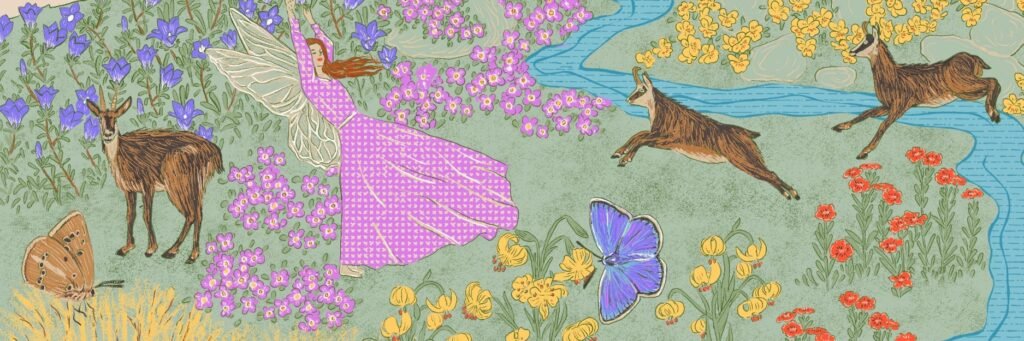
In the highest corners, the Balkan chamois, Rupicapra rupicapra balcanica, walks and runs across impossible rock faces, its hooves gripping ledges where a human would not dare to stand. In the dark, quiet forests, the Balkan lynx, Lynx lynx balcanicus, slips through shadows almost without a sound, golden eyes watching from between branches, one of the rarest and most enigmatic predators in Europe. The brown bear, Ursus arctos, moves mostly at night, heavy yet surprisingly gentle, feeding on berries, nuts, roots and small animals, quietly shaping the forest floor and spreading seeds wherever it goes.

On warmer hillsides and open ground, the Mediterranean tortoise, Testudo hermanni, travels slowly through grass and scrub, its golden-and-black shell a moving sculpture of patience and persistence. At the edge of meadows and forests, the roe deer, Capreolus capreolus, springs forward as if lifted by the air itself, a thin line of grace disappearing into trees.

Above all of this, the golden eagle, Aquila chrysaetos, circles with wide wings over valleys and ridges. On the foulard, as in our real sky, it is more than a bird: it is a reminder of the double-headed eagle on our flag, a symbol of strength, freedom and watchfulness that has followed Albanians for centuries.

In the open air of the design, butterflies drift and flicker. Parnassius apollo glides with white wings speckled by red “eyes”, tied to high, rocky places where the air is thin and the light strong. Polyommatus orphicus flashes intense blue over dry grasslands, proof that even the smallest species can carry astonishing colour. Zerynthia polyxena crosses the silk like a living mosaic of yellow, black and red, appearing in warm valleys rich in wild plants.

On the water’s edge of our illustrated wetlands and lagoons, the great white egret, Ardea alba, stands like a quiet statue in the shallows of imagined Narta, Divjakë or Butrint, its long neck and legs reflected in the surface. The European Stonechat, Saxicola rubicola, perches on a low branch or fence, orange breast bright against the sky, ready to dart after an insect at any second. Over the drawn lagoons of Divjakë–Karavasta glides the Dalmatian pelican, Pelecanus crispus, huge wings beating slowly, its slightly curly head feathers giving it an almost mythical presence. Albania is one of the few places in the world that can still call this bird a regular neighbour.

Near the meandering line of the Vjosa on the silk, we placed one more figure: a mountain fairy with three golden goats, inspired by the tales collected by Mitrush Kuteli. She stands not only for nostalgia, but for the way our culture has always tried to protect nature, through fear, reverence, promises and stories. On the foulard, she watches over everything: the river, the plants, the animals, the space between them.

All of this, the river, the endemic flowers, the dialects hidden in names, the almost invisible animals, live together on one piece of silk.

With Kungul, we fight quietly against products that promise beauty while hiding ingredients that do not belong in or on a healthy body. We also refuse a culture that treats both skin and planet as disposable: too much plastic, too many unnecessary formulas, too many clothes worn once and forgotten.

What you see on this silk is a collaboration, Kungul’s wish for healthier lives and more conscious, better choices, and the Trivet sisters’ talent for turning that shared wish into an image that can travel with you.

It is slow, not fast. It is designed to last, to be repaired, to be loved, to be inherited.
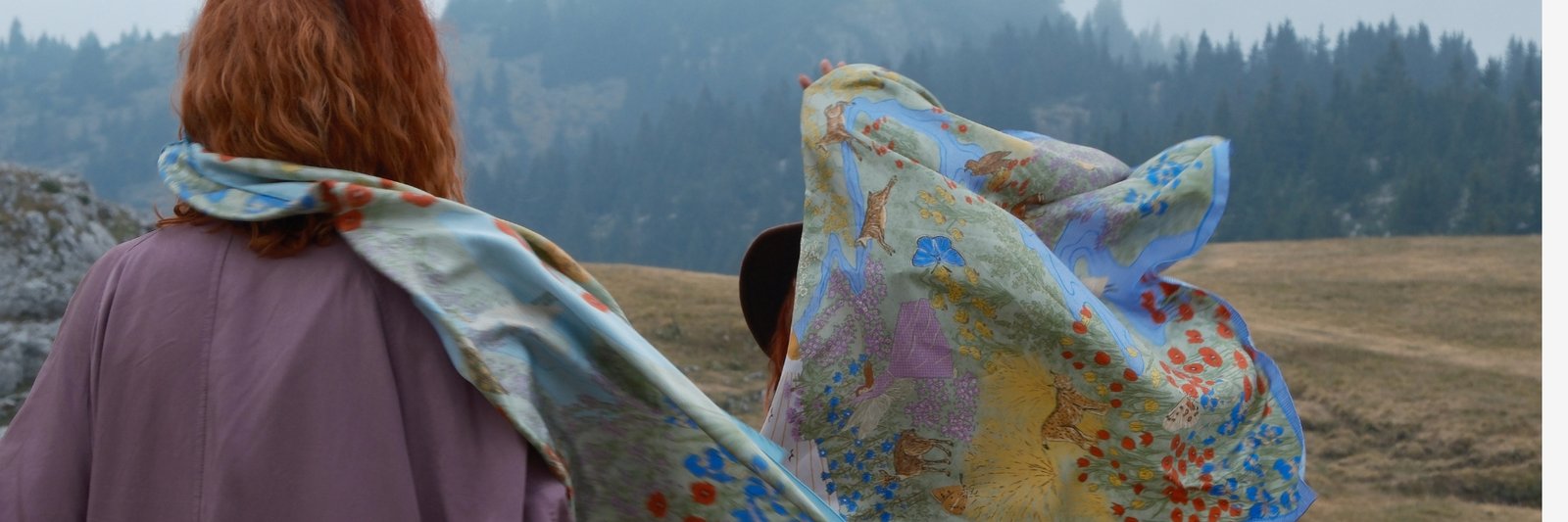
Every time you wear it, you carry a story of rivers that still run free, plants that grow in impossible places, animals that need space and silence, and a country whose richness is often invisible behind marketing noise.

I wrote this not just to describe a scarf, but to invite you into the landscape it holds.

If one day you choose to make this foulard part of your life, our hope is simple: that when you tie it around your neck or lay it gently over your shoulders, you will feel, for a moment, connected to something older, wilder, and more precious than any trend. And if this weave of land, history and living memory speaks to you, you can find the Kungul foulard on KungulApproved.com

By choosing it, you’re also walking a small step with us, helping Kungul continue its path, grow gently, and reach more people with healthier, more mindful choices. 

Ready to Scan?

Just point your camera at a product barcode, Kungul will do the rest. Fast, simple, and always free.

Let’s see what’s inside!