
By Entela Çeliku, PhD in Natural Product Chemistry
Early in my research, I carried the same belief many people have: that plants are gentle, comforting, and safe by default. But the deeper I went into their molecular language, the more I discovered a truth that surprised me, nature can be incredibly potent.
Most of the medicines you see in pharmacies today, from painkillers to antibiotics to chemotherapy drugs, began their life inside a plant. Scientists isolated those molecules, then modified them through synthesis to make them stronger, safer, or more targeted. Nature was the blueprint. Chemistry refined the details.
That was the moment I understood something essential: plants are powerful chemical systems, not soft background ingredients. Their molecules interact with our biology in ways that can heal, stimulate, calm, irritate, or even imitate our hormones.
And this is where the story of hidden estrogens begins.
“Plant-based” has become a synonym for safety. Yet many of the compounds found in essential oils, teas, botanical extracts, seeds, and “clean beauty” formulas can behave like estrogen inside the body, quietly, consistently, and far more often than people imagine.
Why “clean” ingredients can act like estrogen
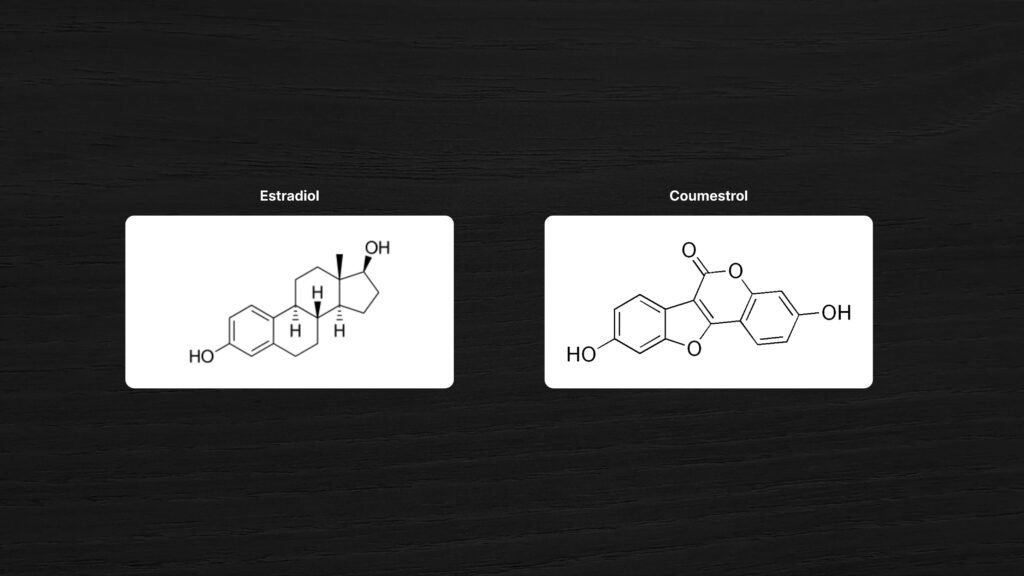
Many plant molecules share a similar structure to estradiol, the body’s strongest estrogen. The body doesn’t care that the molecule came from lavender, fennel, red clover, soy, or flax. It recognises structure, not marketing language.
These plant-derived molecules are called phytoestrogens. They evolved for the plant’s survival, not ours. Plants use chemistry to deter predators, influence reproductive cycles, reduce fertility in grazing animals, and protect themselves from insects.
So when we extract these compounds into oils, teas, tinctures, serums, and supplements, we are concentrating the same molecules plants once used as defence.
And because human hormones work in incredibly tiny doses, even weak or “natural” estrogen-like signals can matter.
How exposure builds up today
Phytoestrogens are not dangerous on their own. The issue is repetition.
Modern women encounter them from morning to night. A herbal tea with fennel. A lavender body cream. A red-clover supplement. A smoothie with flax. Dinner cooked in sunflower or sesame oil. Lavender in the diffuser before bed.Layer this with pesticides, fragrances, plastics, PFAS, stress, and modern diets and the hormonal environment becomes overloaded.
Women with low progesterone, thyroid issues, PCOS, endometriosis, PMS, migraines, heavy periods, or a history of hormonal birth control are especially sensitive. Yet most never suspect the “healthy” or “natural” products in their routine. Many people react strongly only when exposure becomes chronic or layered — a pattern we also see with skin allergies. If you want to understand how the skin becomes reactive over time, you can read our in-depth guide Born Tolerant. Made Reactive. The Truth About How Skin Allergies Develop.
What breast thermography reveals
Breast thermography has given us a rare window into how phytoestrogens behave inside tissue. Estrogen increases heat and blood flow. It stimulates the growth of tiny vessels and increases metabolic activity in breast tissue.
Thermograms often show stronger heat patterns and vascular activity in women consuming high levels of phytoestrogen-rich foods like soy, flax, hops, or black cohosh.
When these women remove the phytoestrogens, the patterns calm.
This is visible physiology, not theory and it matches decades of hormonal research.
The hidden layer in modern food
Most people never think about what their food eats. Today, soy and flax dominate livestock feed. Their phytoestrogens pass into eggs, milk, and meat. Some animals convert them into even stronger metabolites. Without fibre to block absorption, these compounds enter our bodies more easily through animal fats.
This type of exposure didn’t exist for past generations. It is uniquely modern.
How phytoestrogens also affect metabolism
Phytoestrogens influence more than reproductive hormones. They activate metabolic pathways such as PPAR-α, a nuclear receptor that shifts the body toward fat storage. Chronic activation of PPAR-α has been linked to metabolic downregulation and obesity.
There is a reason estrogen has been used for decades in agriculture to fatten livestock.
Phytoestrogens also disrupt thyroid hormone transport and metabolism. Several studies show impaired thyroid function in both diabetic and healthy individuals consuming high-soy diets. Early-life exposure to phytoestrogens has been linked to altered development of the reproductive system, early puberty, reduced fertility, and increased risk of reproductive cancers.
In men, high phytoestrogen intake has been associated with reduced semen quality, altered sperm morphology, and idiopathic infertility.
These findings align with modern trends: declining fertility, earlier puberty in girls, and decreasing testosterone in men.
Awareness, not fear
I love plants. They shaped my career and my curiosity. But loving them also means respecting their power. Many natural extracts behave like pharmaceuticals. Essential oils absorb quickly through the skin. Herbal teas bind receptors. Seed oils influence hormone pathways.
You don’t need to avoid them. You simply need to understand them especially if your hormones already feel sensitive.
| Phytoestrogen | Source | Short Description |
|---|---|---|
| Coumestrol | Red clover, alfalfa, mung sprouts | One of the strongest natural estrogens; binds receptors very strongly. |
| 8-Prenylnaringenin | Hops (beer) | Extremely potent; strong estrogenic effects, especially in breast tissue. |
| Genistein | Soy | Strong ER-β activator; significant hormonal and thyroid impact. |
| Daidzein → Equol | Soy (gut metabolite) | Equol is highly estrogenic and anti-androgenic. |
| Flax Lignans (Enterolactone/Enterodiol) | Flaxseed, sesame | Very high total phytoestrogen load; stimulates estrogenic pathways. |
| Licorice Root | Licorice | Estrogenic compounds that also suppress testosterone. |
| Fennel (Anethole) | Fennel seeds, teas | Pro-estrogenic; traditionally increases prolactin and breast activity. |
| Red Clover Isoflavones | Red clover | Contains multiple estrogenic molecules; used in menopause supplements. |
| Clary Sage Compounds | Clary sage oil | Shows measurable estrogen-like activity. |
| Lavender Compounds | Lavender oil | Mild but real estrogenic + anti-androgenic effects. |
Why Kungul flags many plant ingredients as Yellow or Orange
I know many users feel confused when they scan a product in the Kungul App and see a plant-based ingredient labeled as Yellow or even Orange. The assumption is always the same: “But it’s natural why isn’t it Green?”
Here is the truth: natural is not a safety category.
It tells you where the ingredient came from, not how it behaves in your body.
Kungul scores ingredients based on their molecular activity.
If a plant compound has mild estrogenic or sensitising effects, it appears Yellow.
If it has stronger endocrine or inflammatory potential, it appears Orange.
This does not mean the ingredient is toxic.
It means it is biologically active and your body deserves to know what it’s interacting with.
Kungul’s mission is not to romanticise “plant-based.” It is to explain it. To show when nature is soothing, and when it is stimulating. To give you clarity, not confusion, so you can make choices that truly support your hormones and long-term health.
Your body listens to chemistry.
And Kungul is built to help you listen too.